
Sometimes you genuinely cannot go right now.
But right now and never are two different things.
So if you are Googling how to travel more with a full-time job because your employer has absolutely no intention of letting you answer emails from Bali, I understand the question.
The answer is not always “maximize your PTO.”
It is definitely not “just quit.”
And I refuse to tell you that if you wanted it badly enough, you would magically find a way.
Even after traveling to 42 countries, I still sometimes look at somebody else's life online and think:
How exactly are you paying for this?
Growing up in the rural Southeast, adult life around me looked like work, family, and a few short domestic vacations. The people I saw traveling internationally for months at a time were mostly online, and I rarely saw people who looked like me or came from my background explain the money, work, family conversations, and time off behind it.
Inspiration only gets you so far when nobody explains the logistics.
The Quick Answer: Travel More by Solving the Actual Constraint
- Not enough PTO? Protect the days you do have, use weekends and holidays carefully, ask about unpaid leave, or eventually look for work with better leave.
- Not enough money? Extend the timeline, choose destinations by total cost, build a dedicated travel fund, and change what you spend at home where it actually makes sense.
- Your calendar is rigid? Explore shifts, contracts, seasonal work, school calendars, compressed schedules, or different employers.
- Long flights eat the trip? Travel closer now or change where your ordinary life begins later.
- Family responsibilities? Give the plan more time instead of declaring it dead.
- You want six months away? Stop asking ten PTO days to do an impossible job. Research a career break, sabbatical, contract ending, or planned transition.

First, Figure Out What Is Actually Stopping You
A full-time job does not have to travel with you to make travel possible.
Before changing careers, buying flights, or deciding travel is unrealistic, figure out which resource you are actually missing.
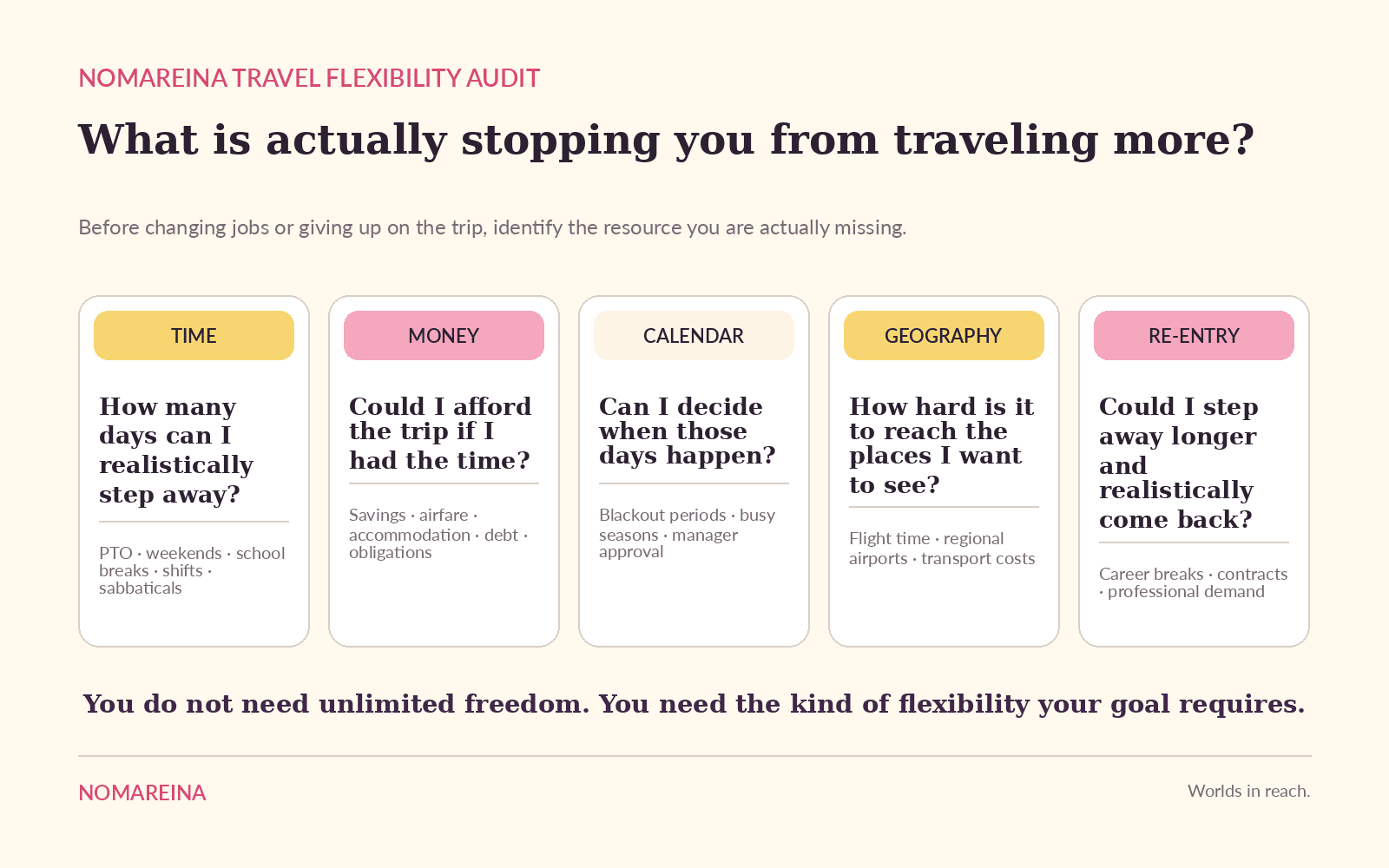
A three-day trip, a three-week trip, and a six-month backpacking trip are not the same problem.
What Worked for Me: A Stationary Job Abroad
Even when I was choosing a career, travel was somewhere in the calculation.
I once imagined medicine taking me abroad through organizations like Doctors Without Borders. Living in Uganda as a doctor sounded just as interesting to me as becoming a digital nomad in Bali.
Then I started teaching in Thailand.
My job was not remote. I had students, a school, a boss, a calendar, rent, water, gas, and obligations.
But I had school breaks, Thai holidays, weekends, and something I had underestimated enormously:
geography.
While working full time, I traveled through Malaysia, Singapore, Laos, Vietnam, Myanmar, Indonesia, Japan, and all over Thailand.
During October breaks, I could sometimes travel for three weeks or more. April gave me another window. Long Thai holiday weekends became domestic trips.
Sometimes school ended around 3 p.m., I went home, picked up my bag, got on my motorbike, and left.


I had somewhere to leave from and somewhere to come home to.
That was not unlimited freedom. It was enough.
Geography Is One of the Most Underrated Travel Benefits
People do not begin from the same map.
I have European friends who think very little of flying from Germany to Spain or London to Málaga. It is a few hours.
In the United States, three hours can get you from Texas to Texas.
Living in Thailand completely changed what counted as a major trip.
Malaysia could be reached by plane or overland. Ferries, trains, buses, and budget airlines gave me different ways to move around the region.
Travel affordability is not only about what you earn. It is also about where your ordinary life starts.

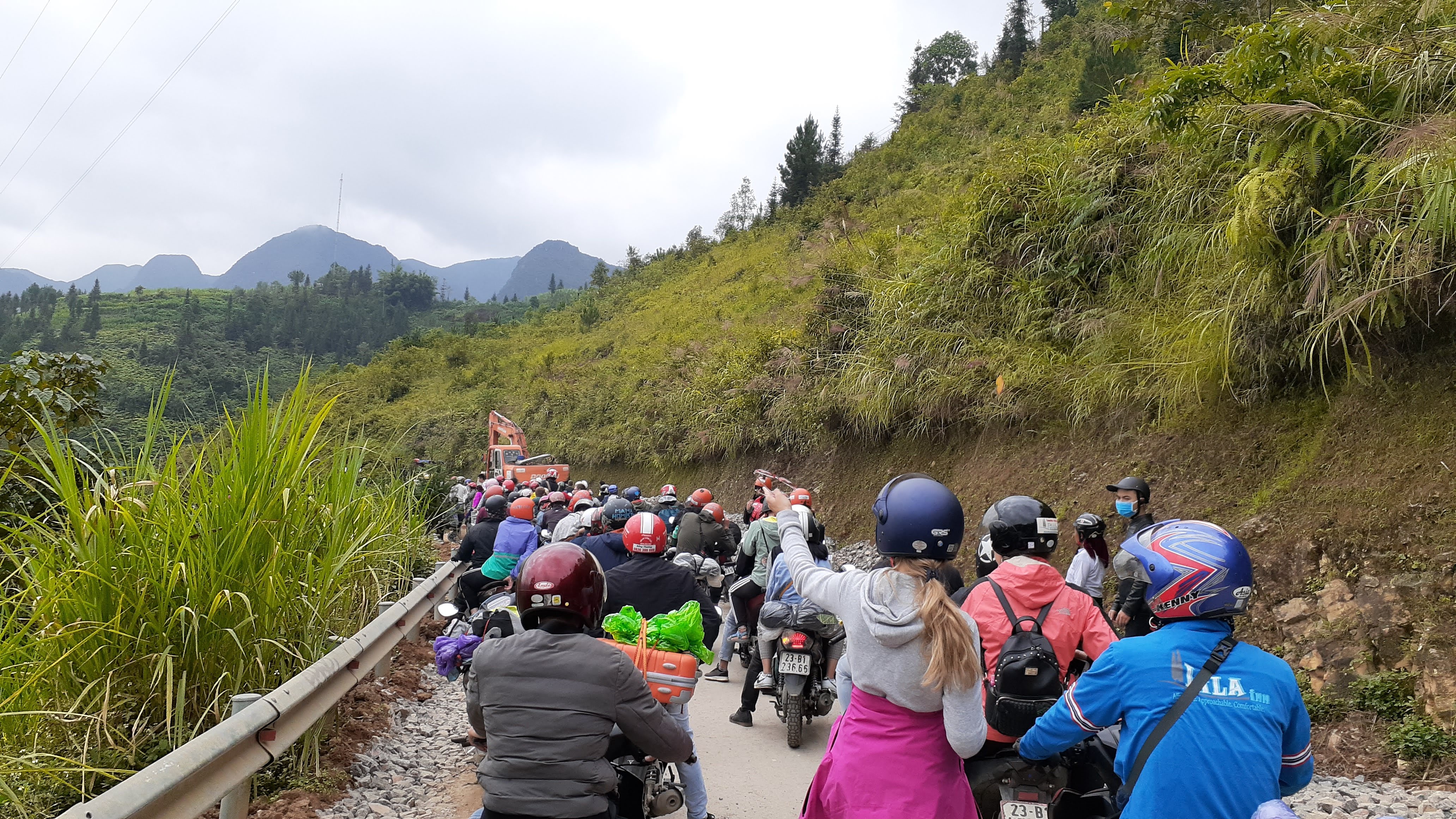
A Travel-Friendly Job Does Not Have to Be a Remote Job
We have made travel-friendly job almost synonymous with laptop job.
That leaves out a lot of people.
Travel-friendly work is a structure, not a job title.
If what you really want is to live abroad rather than travel around PTO, read How to Live Abroad Without Being a Digital Nomad.
PTO Matters, and Some People Genuinely Do Not Have Much
This is where I do not want to pretend everybody simply needs a better Google Calendar.
According to the U.S. Bureau of Labor Statistics, among private-industry workers with paid vacation in 2025:
- 31% received only 5–9 paid vacation days after one year of service.
- Another 31% received 10–14 days.
See the current BLS paid-vacation data →
So if your PTO balance is depressing, I am not going to tell you that you simply have not discovered the correct calendar hack.
Five PTO days do not create the same year as twenty.
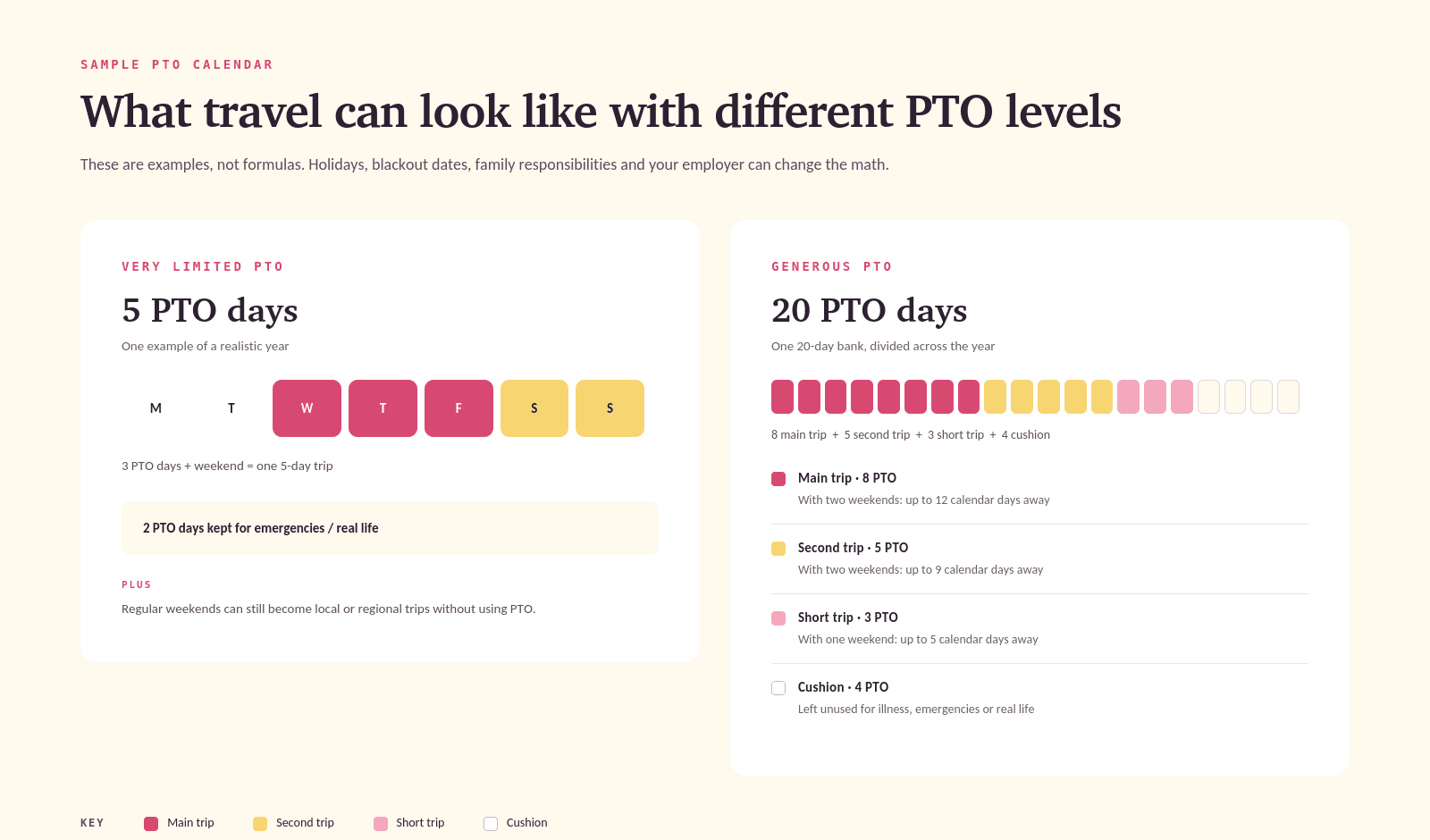
PTO Stacking Works. It Is Not Magic.
Yes, stacking PTO around holidays can work.
A Monday holiday plus several PTO days can turn into a decent trip without using every day you have.
But:
- everybody else may want the same dates
- your employer may have blackout periods
- airlines also know it is Christmas
- hotels also know it is Christmas
- your manager may not have seen the TikTok explaining your perfect nine-day Portugal itinerary
Get the leave approved before you buy the expensive nonrefundable flight.
Use your PTO. It is part of your compensation.
Just leave yourself room for actual life if you do not have separate sick or emergency leave.
Short Trips Work When the Math Works
Three days in Chiang Mai for Songkran?
Absolutely.
Flying twelve hours each way for 48 exhausted hours somewhere because the internet called it “perfect for a weekend”?
Personally, no.
Before I decide a short trip is realistic, I look at both fare and actual travel time.
Losing half of Saturday figuring out logistics is annoying when Saturday is approximately 50% of your vacation.
I once took maximizing my time way too far
For years, if a ferry schedule said I could technically make it, I interpreted that as a challenge.
One trip back from Koh Phangan should have cured me.
I took the last boat to the mainland because I wanted every possible minute on the island. The boat was delayed nearly two hours. By the time I reached land, it was dark, and I still had around a three-hour motorbike ride back to Krabi.
Then the rain started.
My phone died. Fuel dropped toward red. Visibility became terrible.
I made it home.
On another trip, I arrived in Krabi around 3 a.m. and had to be at work at 7.
Could I do that? Apparently. Would I build my current travel philosophy around it? Absolutely not.


Having a Paycheck While You Travel Is Wildly Underrated
Full-time employment can restrict your time.
It can also solve a problem long-term travelers know very well:
Where is the next money coming from?
There is a psychological difference between having $5,000 and needing it to last six months, versus having $5,000 and knowing another paycheck is landing soon.
Without income, every purchase reduces your runway.
Hostel. Train. Flight. Dinner. Activity.
Every swipe shortens the runway a little more.
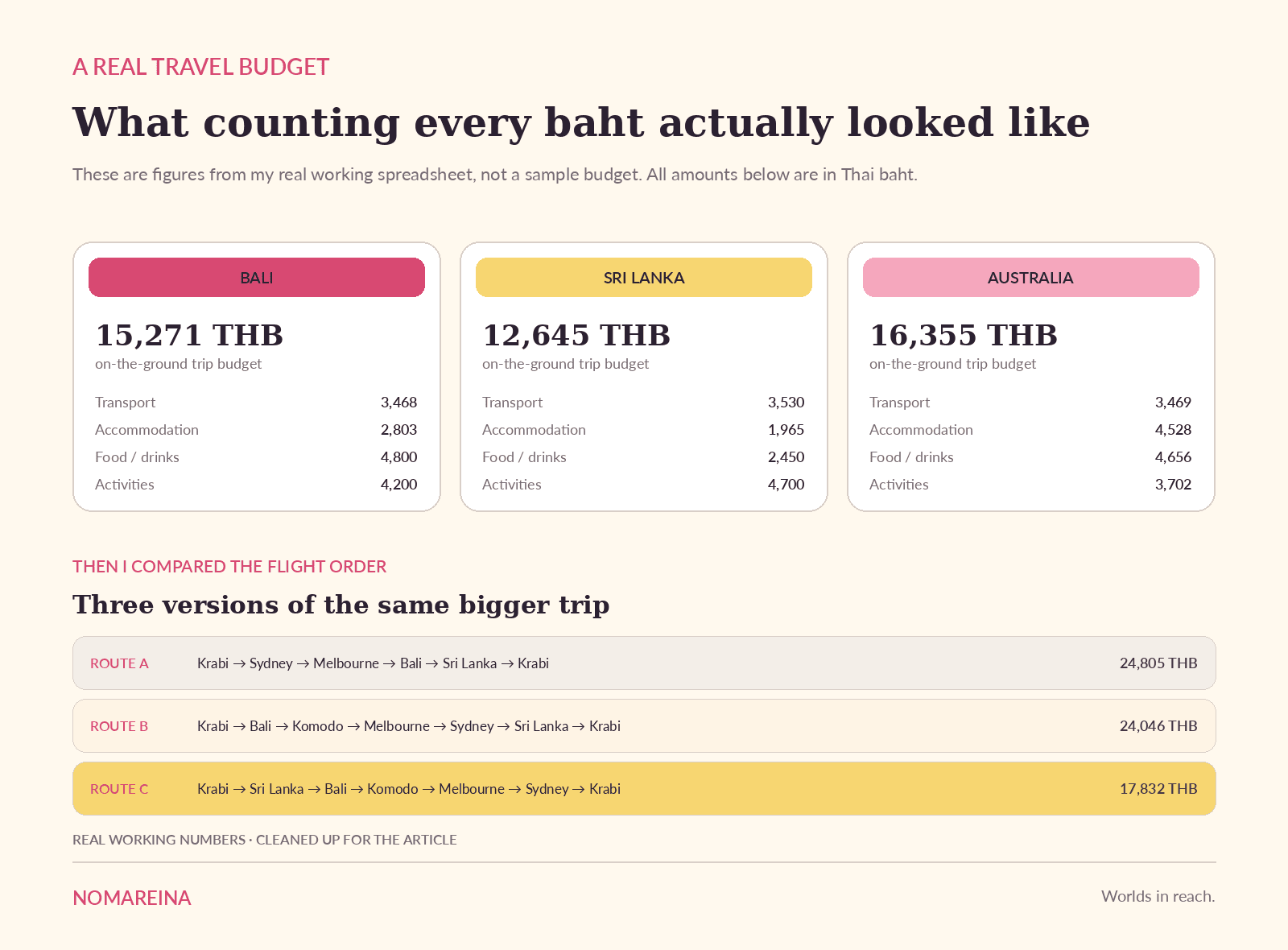
Sometimes the Best Travel Budget Starts With Your Normal Life
Travel was high on my priority list, so I made decisions around it.
- buying secondhand clothes
- choosing cheaper housing instead of automatically upgrading
- eating inexpensive local meals most days
- comparing destinations by total cost, not just desire
- watching airfare closely
- staying in hostels or simpler accommodation
- using overnight transportation when the savings were actually worth it
- saving specifically for school breaks
AirAsia and I had a very serious relationship.
What I am willing to sacrifice has changed.
I will often pay for the bed now.
The better lesson is not that everyone needs to stop buying coffee so they can go to Bali.
It is that most average people have priorities competing for the same paycheck.
Something usually wins. You get to decide what.
Flexibility Is Not Distributed Equally
Money and PTO are not the only things shaping travel access.
Starting position is also your passport, race, gender, family responsibilities, health, culture, and what you were taught was normal.
Race and gender change the planning
As a woman traveling alone, I think about arrival time, transportation after dark, whether I feel comfortable walking alone, and what women who have actually been there say.
A Black or biracial woman may also be asking:
- How have other Black travelers experienced this place?
- Am I likely to stand out?
- How is race understood locally?
- Are there particular situations I should know about?
- Does another woman who looks like me describe feeling comfortable there?
Those questions are not paranoia. They are planning.
I write more about that in Traveling While Biracial.


Family expectations can change access too
For some people, the trip is not only a conversation with an employer.
It can mean coordinating childcare, caring for relatives, managing a partner’s schedule, or explaining solo travel to parents who think the entire idea is insane.
Two people can have the same ten PTO days and still have very different access to those ten days.
Sometimes the Barrier Is Real
There are situations where “I cannot travel right now” is simply true.
- five vacation days
- children whose schedules you have to consider
- a parent or relative who depends on you
- no meaningful emergency savings
- a partner with a completely different calendar
- a profession with seasons when leave is nearly impossible
- health needs that make spontaneous travel difficult
- debt or financial goals that need to come first
Respect the truth.
Then ask whether it has to remain true forever.
I wanted to go to Bali in 2020.
I did not make it there until 2023.
Bali did not disappear because my original timeline failed.
A delay is not always a dead plan.
Kids and Family Change the Equation Too
Children need school, food, documents, healthcare, entertainment, and more planning than my old 23-kilo backpack.
Partners add another calendar too.
There is no productivity hack that erases responsibility.
Travel getting harder does not always mean impossible, but sometimes not now really does mean not now.
Salary Is Not Your Only Compensation
There is an idea I keep returning to:
Time. Money. Freedom.
Everybody wants all three in equal thirds.
Life is less cooperative.
If travel matters to you, time belongs on the compensation spreadsheet too.
- How many PTO days do I actually receive?
- Does PTO roll over?
- Can employees realistically take two consecutive weeks?
- Are there blackout dates?
- Are there company shutdown periods?
- How early does leave need to be requested?
- Can shifts be swapped or compressed?
- Is unpaid leave ever possible?
- Is there a sabbatical policy?
- Are there international offices or placements?
- How flexible is the actual manager, not just the written policy?
A wonderful leave policy managed by somebody who never approves leave is not especially wonderful.
Sometimes you should simply ask
Ask about the extra week.
Then ask about unpaid leave, switching shifts, or the sabbatical.
The answer might be no.
That is still information.
What I Would Do in Five Common Situations
| If this were my situation... | I would start here |
|---|---|
| 10 PTO days + Monday–Friday job | Protect several days for one meaningful trip, use weekends strategically, keep an emergency cushion. |
| Almost no PTO | Use nearby weekend trips now while deciding whether the job’s leave policy fits your long-term life. |
| Money but almost no time | Stop obsessing over cheaper flights and investigate work with better leave or more calendar control. |
| Time but very little money | Extend the timeline, lower costs realistically, build a travel fund, and choose destinations by total cost. |
| I want six months away | Research a sabbatical, contract ending, seasonal work, career break, or planned job transition. |
Your solution should match the size of the problem.
Your Win Does Not Need to Look Like Somebody Else’s
Travel has become another way to keep up with the Joneses, except now the Joneses are wearing linen and allegedly spending six weeks in Santorini.
Not everyone can backpack for six months.
Maybe your win is three weeks.
Or nine days.
Even three.
Three days seeing something you always wanted to see is still three days that once did not exist in your life.
I would love to be writing this from a yacht like Kylie Jenner.
I am not.
We proceed.
Should You Ever Quit Your Job to Travel?
Yes. Sometimes.
Quitting can make sense when you are:
- between careers or at the natural end of a contract
- before graduate school or another planned transition
- taking a deliberate career break with enough savings
- leaving work that has become genuinely unsustainable
But quitting should solve a problem rather than create five new ones.
“I hate Tuesday and watched Eat, Pray, Love” is not a complete financial plan.
If you are planning a longer international trip without employer coverage, compare the current policy details rather than assuming ordinary vacation insurance is enough.
Quitting is one option. It is not morally superior to taking PTO.
Travel Differently When Your Life Changes
I still loosely want to reach 100 countries one day, but 42 is already a lot of countries.
The number is no longer the point.
I travel slower now. I want to learn languages, understand neighborhoods, make friends, return to places I love, and build community instead of constantly chasing the next pin on a map.
After years in Thailand, one Buddhist idea stayed with me more than most:
things change.
Careers, finances, obligations, and travel styles change too.
The fact that one version of travel is impossible for you now does not mean every version is.
Before You Close This Tab, Figure Out Your Next Move
Do not judge the answer.
Use it.
You may take path 1.
I may take path 145.
Somebody else may stand still for five years before the right road opens.
Realistic does not mean giving up. It means changing the plan until the plan fits your life.
Traveling With a Full-Time Job FAQ
How can I travel more with a full-time job?
Start by identifying whether your biggest constraint is PTO, money, calendar control, geography, exhaustion, or something else. Solve that problem rather than copying a generic travel hack.
How can I travel if I only have 10 vacation days?
Ten days will not create the same travel year as twenty or thirty. Use weekends and holidays where useful, protect the trips that matter most, and keep enough leave for real life if you need an emergency cushion.
Can I travel often without working remotely?
Yes. Teachers, healthcare workers, seasonal workers, contractors, flight attendants, cruise workers, and people with ordinary PTO policies all travel in different ways.
Is one long vacation better than several short trips?
It depends on distance and your travel style. Short trips work well for nearby destinations. Longer trips make more sense when transit or jet lag would eat too much of a short itinerary.
Should I quit my job to travel?
Sometimes. Consider savings, debt, career re-entry, healthcare, family responsibilities, emergency money, and what happens after the trip. Quitting is one strategy, not the only serious way to travel.
Join the conversation
How are you able to travel with a full-time job?
Help a soul sister or brother out and leave a note in the comments See the Policies & Disclaimers.