
I hadn’t even made it back to the United States yet when I started wondering if coming home was a mistake.
Somewhere between Tokyo and Houston, an elderly woman asked a flight attendant if she could help lift her bag into the overhead compartment. “No,” the flight attendant said. “You have to be able to lift your own bag. We can be sued if something happens while we’re helping.”
The flight attendant was American. And after years of living abroad, my immediate thought was: That is the most American thing I have heard in a very long time. I wasn’t moving home yet. This was my first visit back in years. But apparently my reintroduction to the United States was going to begin with liability.
Things did not become less strange after I landed.
I didn’t know how to contact anyone. For years, I had used WhatsApp, Messenger and Line. I could not remember the last time I regularly sent an SMS. Meanwhile, everyone in America seemed to still be texting each other, so I resorted to finding old friends on Instagram because I assumed I no longer had their numbers.
Later, when I finally had an American phone number again, I tried some of the contacts still sitting in my phone. They worked. People were using the exact same phone numbers I had saved for them in high school. I had gone through more phone numbers than I could count. Apparently, while I had been changing countries, SIM cards and messaging apps, everyone else’s phone number had been preserved like fossils.
That first visit should probably have warned me that eventually moving back home would not feel like returning to a life I had paused. It felt much more like moving somewhere new.
That disorientation is often called reverse culture shock. I wrote separately about why moving back home after living abroad can feel so strange. This is about the part I found harder to answer:
What do you actually do once you’re back?
Disclosure: This article contains an affiliate link. If you use it, I may earn a commission at no additional cost to you. I only recommend services I believe may be useful to NomaReina readers.
How do you adjust after moving back home from abroad?
Treat coming home like another move. Relearn the systems that changed, rebuild ordinary routines, reconnect without expecting old relationships to pick up exactly where they left off, and deliberately keep the parts of yourself you liked abroad.
You are not trying to recreate your old life. You are building a new one in a place you happen to recognize.
Treat coming home like another move
This was the first thing I got wrong.
When you move to another country, you expect confusion. You expect to ask questions and to misunderstand things. You expect not to know how the transportation system works, where people shop, what app everyone uses or how some random administrative process works. You give yourself permission to be new.
Coming home is harder because you think you are supposed to know everything already. I grew up in the United States. Surely I knew how America worked. Except the America in my head was several years old. The country had kept moving while I was gone. So had my friends. So had my family.
And so had I.
What helped was treating the first few months home the same way I would have treated arriving somewhere new. Instead of asking, Why don’t I know how this works anymore?, I started asking:
How does this work now?
That tiny change made it much easier to learn without turning every unfamiliar thing into evidence that I no longer belonged. If you have just moved home, give yourself permission to be a newcomer for a while, even if the place technically isn’t new.
It also helps to write some of it down. Once home starts feeling normal again, it’s easy to forget how strange the beginning was and how much you figured out along the way.
Let yourself relearn things you used to know
I had driven before I left. I knew what the pedals did. But I had spent years getting around by motorbike and public transportation, and I didn’t need a car for most of my life abroad. Then suddenly I was sitting behind the wheel again, and something that had once been completely normal felt unnatural.
There were smaller versions of this everywhere:
- how people communicated
- new apps
- slang
- cultural references everyone else seemed to understand immediately
- people, scandals and internet moments I had completely missed
There were conversations where everyone would react to something while I sat there trying to work out whether this was information I was supposed to have. At first, I was embarrassed. Then I realized how ridiculous that was. If I had moved to another country, I would have happily asked, “What does that mean?” But because I was home, I felt like I was supposed to pretend.
Don’t.
- If driving feels strange, practice again.
- If you don’t understand an app, ask someone to show you.
- If everyone starts laughing about something you have never heard of, ask what happened.
- If a system has changed, learn the new version instead of pretending you already know it.
Treat anything unfamiliar exactly the way you would have treated an unfamiliar system abroad, and figure it out one thing at a time.
Remember that everyone else got the updates slowly
One of the strangest parts of moving home after years abroad is that you notice changes differently from the people who stayed. They experienced them gradually. You don’t.
The decline in the quality of certain goods surprised me. Things I remembered being better seemed cheaper or flimsier. For everyone else, those changes happened slowly. For me, there was an old version of America stored in my head, and then suddenly I was standing in the new one.
It was like running America on an operating system several updates out of date. Everyone else had installed each update as it arrived. I had skipped all of them, then came back and downloaded everything at once.
That applies to more than products:
- prices
- technology
- social norms
- language
- work culture
- dating
- how people communicate
- how people spend their free time
Sometimes the thing that feels deeply foreign is not actually dramatic at all. You just missed all the small steps that made it normal to everyone else. If something shocks you after moving home, ask yourself:
Did this change overnight, or did I simply experience several years of change all at once?
That question helped me stop interpreting every difference as proof that I no longer understood my own country. Sometimes I was just catching up.
Update your practical systems one at a time
Some of the adjustment is emotional. A lot of it is paperwork.
While you were gone, the practical parts of life kept changing too. Don’t try to fix all of it in your first week. Make a list and work through what you need soonest.
- Phone: Get a local number early, since banking, appointments and two-factor logins may depend on it.
- Banking and payments: Check whether your old accounts still work, how you will access money you still have overseas and what apps people use to pay each other now.
- Healthcare: Figure out your insurance situation before you need a doctor, not after.
- Transportation: Update your license or other transportation documents if needed, and give yourself time to get comfortable again.
- Work: Update your résumé, LinkedIn, professional profiles and anything else that still says you live somewhere else.
If you are still holding money in another currency or transferring money between countries, a multi-currency service such as Wise may be useful while you get everything reorganized.
Affiliate link · no additional cost to youEach one you check off makes home feel a little less like a system you don’t understand.
Reconnect with old friends, but don’t expect the old friendship back
This part was harder.
I understood that people had built lives while I was gone. They had careers, relationships, children, new friends, responsibilities and routines that did not include me. That makes perfect sense when you say it like that. It still hurt.
There were people I expected to make more effort to fit me back into their lives. Some didn’t. And I struggled with that because I kept thinking, I would make time for you. Coming home forced me to accept that some relationships had changed even if I did not feel like my attachment to those people had changed.
You may experience the same thing. Instead of expecting everything to resume where it stopped:
- invite someone for coffee or spend time together one-on-one
- ask about the years you missed instead of only talking about yours
- notice who consistently makes room for you
- let yourself acknowledge when a friendship now exists mostly because of history
Sometimes you reconnect and the friendship feels surprisingly easy. Sometimes it comes back in a different shape. Sometimes nostalgia was doing the actual work.
Build a new social life too
There is a strange assumption built into moving home that you already have a community there. Sometimes you technically do. That does not necessarily mean it still fits.
Your old friends may live far away. Their schedules may be completely different. Some may have children or partners, and some may simply be in a different stage of life. Treat community the same way you would if you had moved to a new city. That might mean:
- taking a class
- volunteering
- joining a professional group
- playing a sport
- picking up a hobby
- finding a religious or cultural community
- joining travel groups
- simply becoming a regular somewhere
You do not have to choose between your old relationships and new ones. You can have both. And you are allowed to meet people who know the version of you that exists now.
If rebuilding a social circle is the part you’re struggling with, my guide to how to make friends after moving abroad goes deeper into building community when you are starting from scratch.
Rebuild your routine before you make huge decisions
When your life feels unfamiliar, it is very easy to jump straight to enormous questions:
- Do I belong here?
- Should I leave again?
- Was moving home a mistake?
- Where am I supposed to live?
Those are difficult questions to answer when you do not even know what you normally do on Saturday morning. Ordinary routines helped me more than dramatic conclusions, so start smaller:
- figure out where you grocery shop
- find somewhere you like to get coffee
- decide what you do when you want to get out of the house
- find a gym, park, class, library or hobby group
- create a normal weekday
- create a normal weekend
A place starts feeling like yours through repetition. That was true when I moved abroad too. The foreign grocery store eventually became my grocery store. The road I didn’t know became the road home. The strange routines stopped being strange.
Coming back required some of the same process. Before deciding that home no longer fits you, give yourself enough ordinary life there to actually find out.
Coming home changed what you want from work too?
If returning home has you rethinking your job, schedule or how much flexibility you want, I made a free guide with 25 places to look beyond the usual job boards for remote work, project work, contracts and other flexible options.
Get the Flexible Work Guide →Protect the parts of yourself you liked abroad
This is something I still have to pay attention to.
When I lived abroad, traveling somewhere far away because it was Saturday did not feel particularly dramatic. I would just go. There didn’t need to be a group chat or a six-month planning process. I didn’t need five other people to confirm that they were free before I could decide whether I wanted to see somewhere. If I wanted to go, I went.
Back in the U.S., I noticed myself becoming more hesitant. Maybe I would wait for a group trip. Maybe I would plan something months in advance. Maybe I would think about going somewhere and decide it made more sense to wait until someone else was available.
I don’t know exactly when that happened. But I noticed it, and I didn’t like it.
One of the mistakes I made was assuming that adjusting meant reverting to the person I had been before I left. It doesn’t. Think about the parts of your life abroad that you genuinely liked about yourself. Maybe you:
- walked everywhere
- traveled more spontaneously
- cooked more
- spent more time outside
- spoke another language regularly
- were more social
- were more curious
- tried things without needing to know exactly how they would turn out
Choose a few of those things and deliberately bring them home with you. For me, that means reminding myself that I do not need a group trip to go somewhere. Sometimes I can just go.
And if returning home has made travel harder because you are back on a traditional work schedule, I also have a guide on how to travel more with a full-time job.
Don’t use every bad day to decide whether moving home was a mistake
This is an easy trap. You have one terrible week and suddenly: I never should have come back. Then you have a great weekend and think: Actually, this was definitely the right choice.
Neither one proves much.
Returning home can make you hyperaware of comparison:
- this restaurant versus the one you loved abroad
- this weekend versus the weekends you used to have
- this friendship versus the friendships you left behind
- this version of yourself versus that one
Try not to make every uncomfortable day into a final verdict about where you should live. You can miss your old life and still build a good one at home. You can enjoy being home and still miss living abroad. You can eventually decide to leave again without treating the time you spent home as a failure.
Sometimes a bad Tuesday is just a bad Tuesday.
Give yourself something new to build toward
One thing that made returning harder was the feeling that I had already lived the interesting part. Abroad had movement: new places, new people, new problems. Then I came home, and it was easy to frame that as an ending.
I think it helps to have something that makes your life feel like it is moving forward again. That might be:
- a career change
- a class
- a fitness goal
- saving for another trip
- volunteering
- learning something
- building a business
- starting over in some completely unrelated part of your life
For me, NomaReina became one of those things. I had years of stories, mistakes, conversations and questions from living and traveling abroad. Building something from them gave those experiences somewhere to go.
Your thing does not need to be travel-related at all. The point is to stop waiting for your old life to restart and give the current version of you something to move toward.
If you’re overwhelmed, start here
You do not need to rebuild your entire life in one month. Start with a few specific things you can actually finish:
- Get connected: local phone number, logins, bank accounts and payment apps.
- Get current: healthcare, appointments, identification, license, address and important accounts.
- Reconnect: message a few people individually instead of waiting for your old social life to reappear.
- Rebuild your week: choose a couple of routines and one place that starts feeling like yours.
- Keep what mattered: write down what you liked about yourself abroad and decide how you will keep some of it.
- Choose what comes next: pick one new goal so returning home does not become only about looking backward.
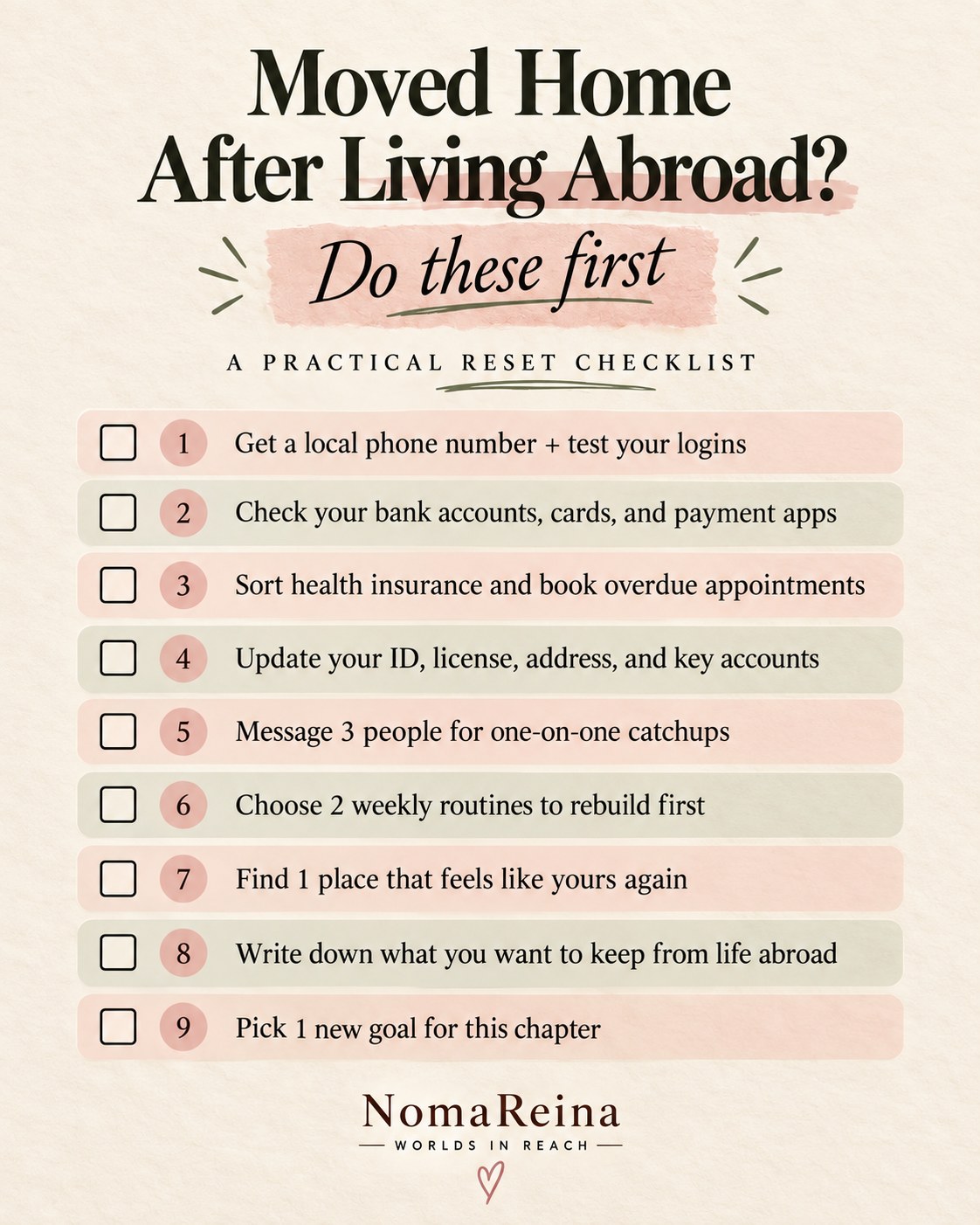
Those things will not make home instantly feel familiar. But they give you something more useful than familiarity.
They give you a life.
Home becomes ordinary again. Just not in the same way.
Eventually, some things stop requiring so much thought. Driving feels normal again. You understand more of the references. You find places you like, and you stop noticing every single difference between home and wherever you lived before.
Some old relationships settle into whatever they are going to become. New ones begin. You create routines that did not exist before you left and were not waiting for you when you came back.
I don’t think adjusting after living abroad means getting your old life back. I’m not even sure that should be the goal.
Maybe it is learning how to live in a familiar place as the person you became somewhere else.