
The first time I moved abroad, I had something waiting for me.
The second time I looked for work in Thailand, I was technically homeless, living out of a backpack and flying across the country whenever a school called.
Both worked.
But if you asked me now whether you should find a job before moving abroad, my answer would not be a clean yes or no.
If you're asking this question, you're probably not choosing between being responsible and being reckless. You're trying to figure out which kind of risk you can actually live with.
Sometimes having the job first is exactly what makes leaving possible.
Sometimes being in the country is exactly what makes getting the job possible.
I learned both lessons in Thailand.
Do you need a job before moving abroad?
No, not always. For some countries, visas and industries, the job has to come first. In others, you may be able to legally move there first and have a much better chance of finding work once employers know you are actually in the country.
That second route worked very well for me in Thailand, but only because:
- I had enough money to support myself while I searched.
- I understood that I could not legally start working until my immigration status was sorted out.
- I had a realistic backup plan if I did not find something.
The real question isn't job first or move first. It's which order gives you better odds without putting your legal status, money, or backup plan at risk.
At 22, I Needed Something Waiting for Me
I found my first opportunity in Thailand almost by accident.
I was still in university when I saw that a friend of a friend was going to Thailand. I messaged her, got the information for the organization she was using and applied online.
That was basically my grand strategy.
I wasn't:
- comparing salaries
- researching the Thai job market
- comparing different schools and cities
- studying visa options
- figuring out what teachers were normally paid
I didn't even really know how to get a job in Thailand.
I saw a way to go, and I took it.
I was nervous because I didn't know much about the organization. Luckily, the friend of a friend left for Thailand in June and I wasn't going until August. By the time I needed to leave, she could tell me the agency was real and that she had actually arrived safely.
That was enough reassurance for me.
Looking back, I was brave. Adventurous. A little ridiculous. Maybe crazy.
But I wasn't stupid.
I had never been to Thailand. I knew almost nothing about living there. At 22, there is no way I would have gotten on a plane with absolutely nothing waiting for me on the other side.
I needed something.
The volunteer position gave me that.
It also came with a pretty big downside.
I Was So Focused on Going That I Didn't Ask Whether It Was a Good Deal
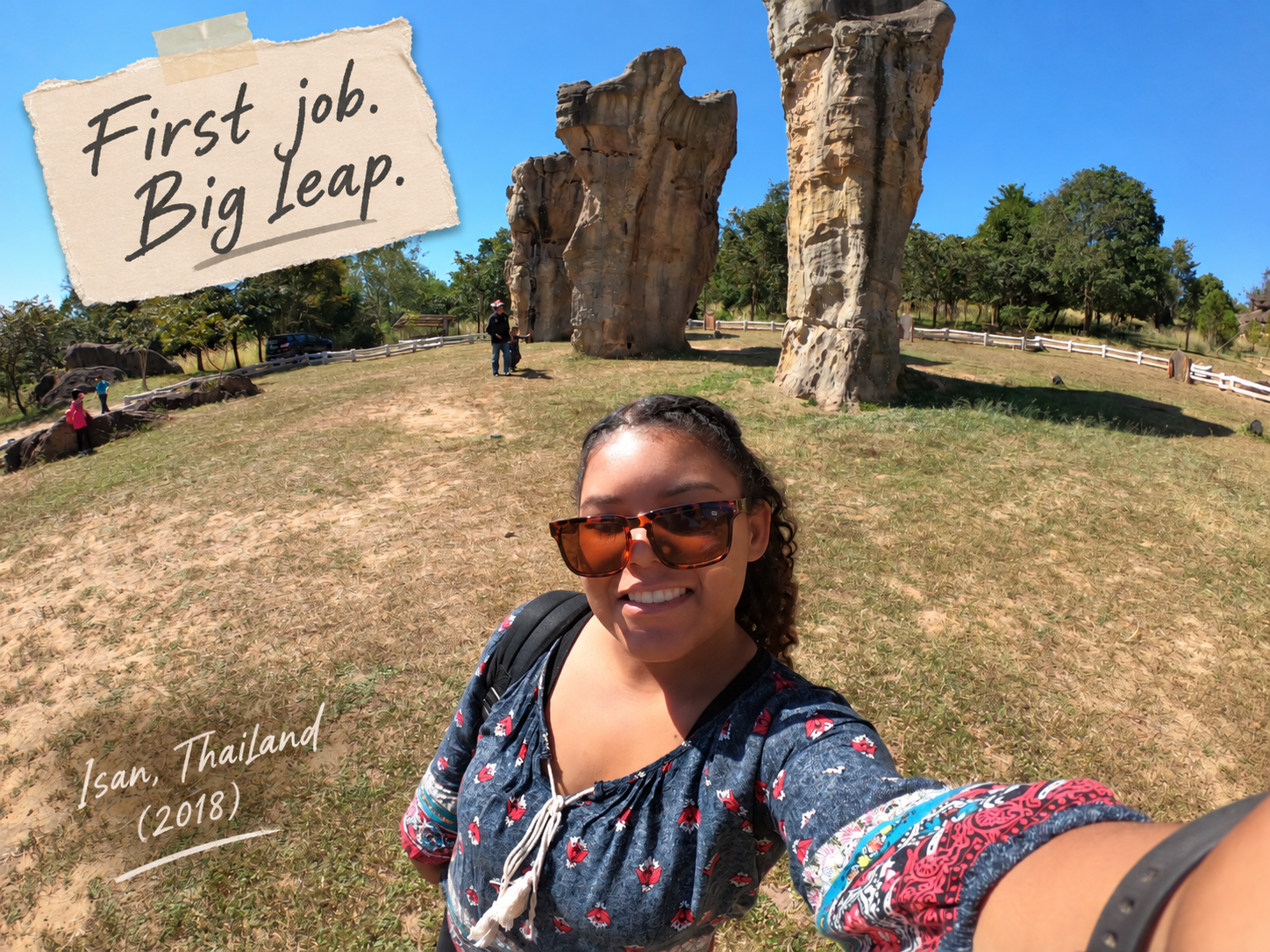
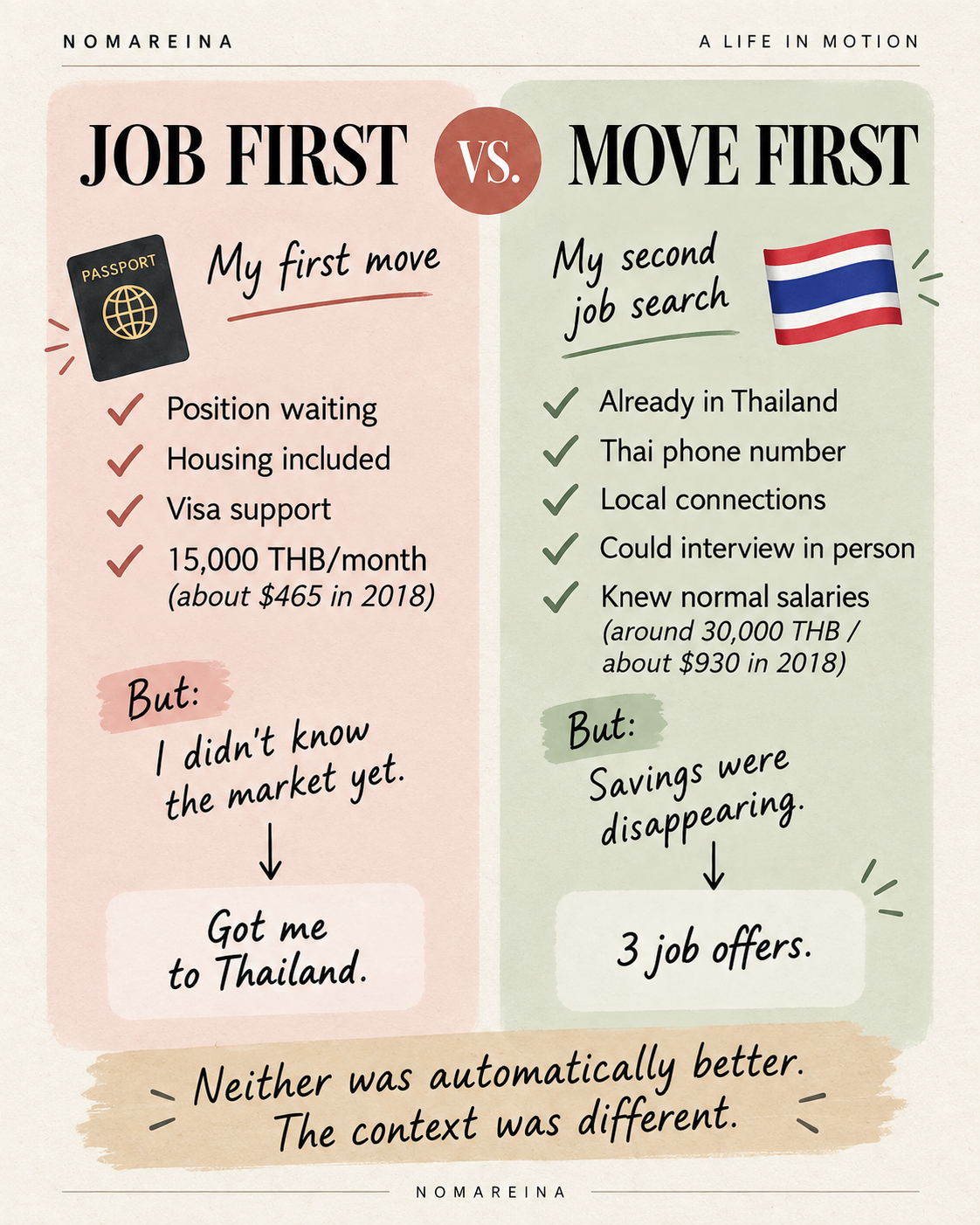
The position paid me 15,000 baht per month. Using the average exchange rate from 2018, that was roughly $465 a month. Housing was included, and I had support with the visa process.
At the time, I thought that was just what you got paid.
It wasn't.
Once I actually lived in Thailand and started talking to other teachers, I realized I was qualified for jobs paying around 30,000 baht per month. In 2018 dollars, that was roughly $930 a month.
Double.
I had:
- a university degree
- a science background
- the qualifications to teach
I could have gone after a regular paid teaching position from the beginning.
I just didn't know that.
I was in a rush to go. I didn't know where to start, and I didn't do enough research.
It worked out in the end, but this is also one of the reasons I started NomaReina.
I don't want someone else to have to start from zero just because I did.
You should be able to stand on the backs of the people who already went.
Learn from what we got right.
And definitely learn from what we got wrong.
My first step into Thailand was a little bit of a miss.
But it got me there.
And getting there changed everything.
Is It Easier to Find a Job After You Move Abroad?
For me, yes.
Much easier.
Once I was in Thailand, I finished my first contract and decided not to renew it. The pay was too low, and by then I knew I could do better.
More importantly, I finally understood how teachers were actually finding jobs.
That information did not come from sitting at home Googling Thailand.
It came from being there.
By then:
- I knew what other teachers were earning.
- People told me which schools were hiring.
- I had help finding schools to contact.
- I knew where people were sending cold emails and making cold calls.
- I had connections.
- I understood the cities better.
A lot of the opportunities around me were local. The schools already had teachers in Thailand applying. Some were not trying to recruit internationally at all.
Suddenly, the job market didn't feel like this mysterious thing happening 9,000 miles away.
I was inside of it.
And employers knew it.
Schools Could Call Me and Say, “Can You Come In?”
This was probably the biggest advantage I had.
I had a Thai cellphone number.
Schools would call me.
I would send a resume, and maybe five or seven days later my phone would ring. Then they would ask me to come to the school for an interview.
Sometimes I had very little notice.
I once got on a flight to Chiang Mai with about five days' notice because a school wanted to interview me.
When they told me to be there at noon or 2 p.m., I was there.
I showed up with:
- proper clothes
- my resume in hand
- my degree and science background
- enough basic Thai to show that I had been living in the country and making an effort
That is very different from applying while sitting in the United States.
A school in Thailand didn't have to wonder whether I was actually serious about moving.
I was already there.
They didn't have to wonder whether they would offer me a job and then I'd panic about moving across the world and never show up.
They could call me.
I could show up Monday at noon.
And I think that gave me an upper hand.
Some of the Best Jobs I Found Weren't Looking 9,000 Miles Away
Some of the schools I applied to weren't really looking overseas.
They didn't need to.
There were already qualified teachers in Thailand looking for jobs.
Plenty of them.
Why coordinate around:
- a massive time difference
- international travel
- a candidate who may or may not actually relocate
when someone else can walk through the front door tomorrow?
Koh Samui, for example, can have teachers waiting for openings at good international schools. The schools don't necessarily have to search very far.
That doesn't mean every industry works this way.
It doesn't even mean every school in Thailand works this way.
But for the jobs I was pursuing, being local mattered.
Being physically present didn't magically make me qualified. My degree mattered. My science background mattered. My teaching experience mattered.
But being in Thailand meant I could actually get in front of the person making the decision.
I Got Interviews in Every City I Wanted
I was looking at jobs in:
- Phuket
- Chiang Mai
- Krabi
I got interviews in all three areas.
Phuket eventually fell away as a serious choice for me. At the time, I had some pretty strong feelings about the island, particularly the tourist-heavy areas, prices and the version of Phuket I had experienced as a backpacker.
Years later, I realized some of those opinions were really opinions about Patong, not the entire island. I wrote about that change of perspective in I Thought I Hated Phuket. Then the Tourists Went Home.
When I was deciding where I actually wanted to build a life, though, I narrowed my choices to Chiang Mai and Krabi.
Of the interviews I did, I received three job offers.
Eventually, I narrowed those offers down to two:
- a nice international school in Chiang Mai
- a public school in the south
I loved Chiang Mai. I still think of it fondly.
But the other job put me near the beach.
That made the decision pretty easy.
I chose the south.
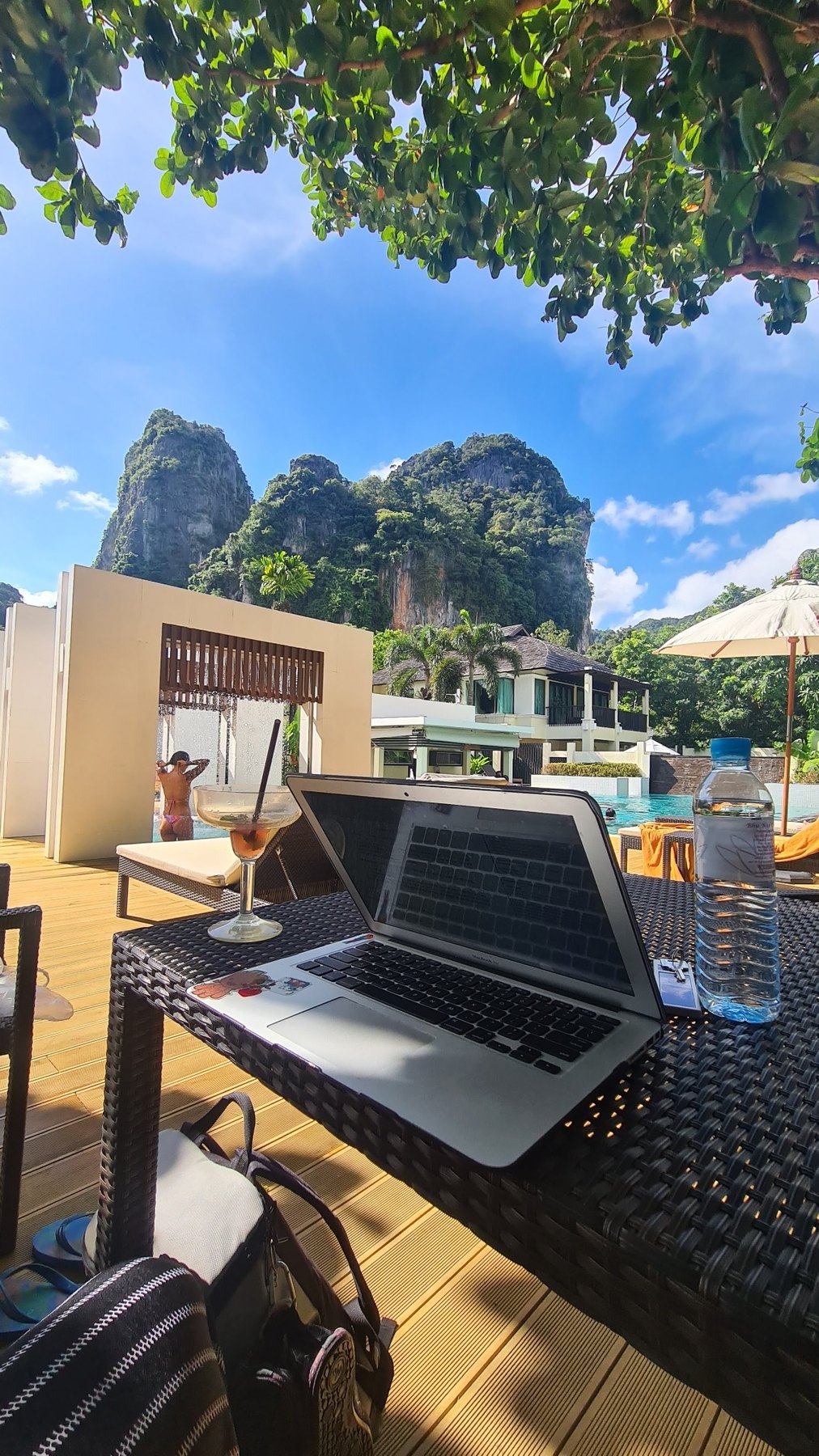
Krabi had already made an impression on me. I had visited looking for the Thailand I had pictured before I ever moved there: limestone cliffs, islands and water so blue-green it almost looked fake.
Eventually, that part of Thailand became home.
I tell more of that story in Things to Do in Krabi, Thailand: What I’d Prioritize After Years in the South.
That teaching job became one of the reasons one year in Thailand eventually turned into five.
And I don't think I would have gotten there the same way if I had stayed home.
The opportunity existed because I was right where I needed to be for the next step.
The first step wasn't perfect.
But it put me in position for the second one.
For About Four Weeks, I Was Technically Homeless
There was a weird little period between those two lives.
My belongings were in storage in Bangkok.
I was staying with people I knew.
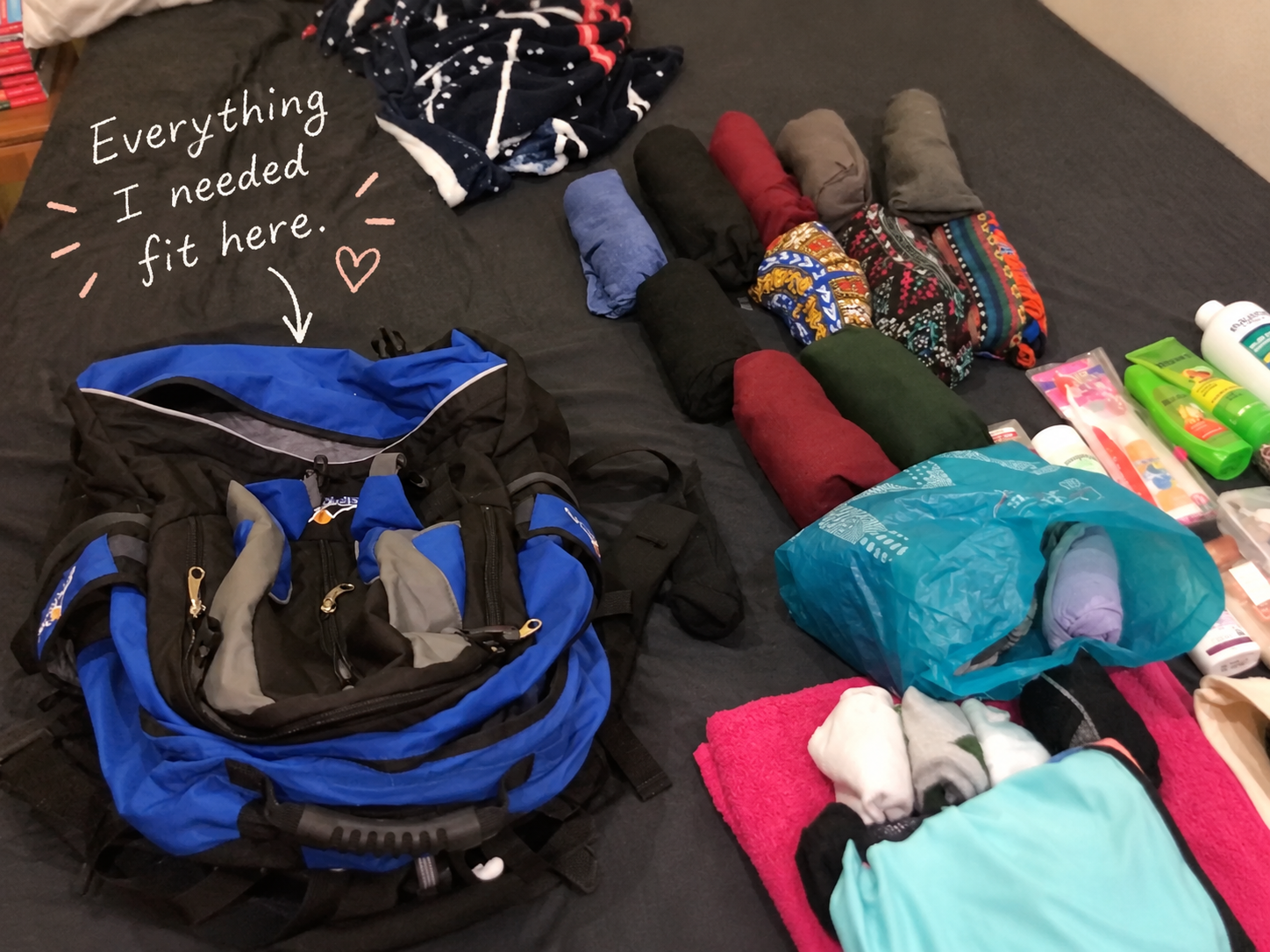
Everything I actually had with me fit into my backpack and the smaller bag I carried in front.
I remember thinking:
Which sounds horrible.
But at the time?
I was having a great time.
During those four weeks:
- I went backpacking.
- I went to Koh Chang.
- I went to Bangkok with friends.
- I visited national parks.
- I applied for jobs.
- I lived off what remained of the roughly $2,000 I had originally brought with me.
For most of those weeks, I was fine.
Until the money started getting lower.
And lower.
And lower.
Then it stopped feeling quite so carefree.
This is where the romantic version of “just move and figure it out” starts running into reality.
Your options look very different when you still have money.
If you're trying to figure out how much financial runway you would actually need, I wrote much more about that in How Much Money Do You Need to Move Abroad?
30 Questions to Ask Yourself Before Moving Abroad
If the job question is only one piece of what you're trying to figure out, use this as the broader reality check: money, work, lifestyle, community, timing, expectations, and what you actually want your life abroad to look like.
- Work
- Money
- Community
- Timing
- Expectations
Affiliate disclosure: Some links on NomaReina are affiliate links. If you use one, I may earn a commission at no extra cost to you.
If I were doing this now, I would figure out how I planned to access, move and convert my money before I landed. Wise can be useful for holding and converting multiple currencies and sending money internationally. Features and fees depend on where you live and what you're doing.
Being There Gave Me an Advantage. It Did Not Remove the Risk.
I was fairly confident I would find something.
And if I couldn't find a job directly with a school, I knew agencies existed.
They could place teachers.
That was my backup plan.
The tradeoff was that agencies could mean:
- less control over which school you were placed with
- lower pay
- a middleman taking part of the money
I wanted to find a school directly.
Fortunately, I did.
But by the time I accepted the job, my money was getting uncomfortably low.
And getting the job wasn't the final step.
I still needed the proper immigration status before I could legally work.
At the time, my process required leaving Thailand and applying for the appropriate visa through the Thai embassy in Malaysia.
That turned into its own disaster when I arrived missing a document and initially got denied.
I looked desperate enough that they eventually took pity on me and let the missing document slide.
That story deserves another article.
The important part here is that moving first does not mean working illegally and figuring out immigration later.
Those are two very different things.
I was able to interview while I was in Thailand. Before I began working, I still had to go through the immigration process required at the time.
And what happened to me years ago should not be treated as a step-by-step visa guide for Thailand today.
Immigration rules change.
Thailand's Ministry of Foreign Affairs currently identifies the Non-Immigrant B visa as the category used for employment and says a person must have a work permit before starting work. Check the current rules for your own nationality and situation before making plans. Thai MFA guidance ↗
Can You Move Abroad Before Finding a Job?
Sometimes.
But this is where destination, nationality, visa type and industry matter enormously.
Some countries require you to have an employer or qualifying job before you can get the immigration status that allows you to move there for work.
Other countries have pathways that make moving first and finding work second more realistic.
Australia's Working Holiday Maker program is a good example. It includes visas that let eligible young adults travel in Australia and work while they are there. Eligibility depends on your passport, age, the visa subclass and other requirements.
But notice the order.
You get the visa first.
You don't enter as an ordinary visitor, find a job and assume everything will work itself out.
Before planning to find work after arrival, figure out two things:
- Can you legally do it?
- Does being there actually improve your chances of getting hired?
Australia Working Holiday Maker guidance ↗
Would I Move Abroad Without a Job Now?
Under the right circumstances, yes.
Actually, for certain types of jobs abroad, I would rather arrive legally with runway and job hunt in person than spend months applying from 9,000 miles away.
But I would not do it as blindly as I did at 22.
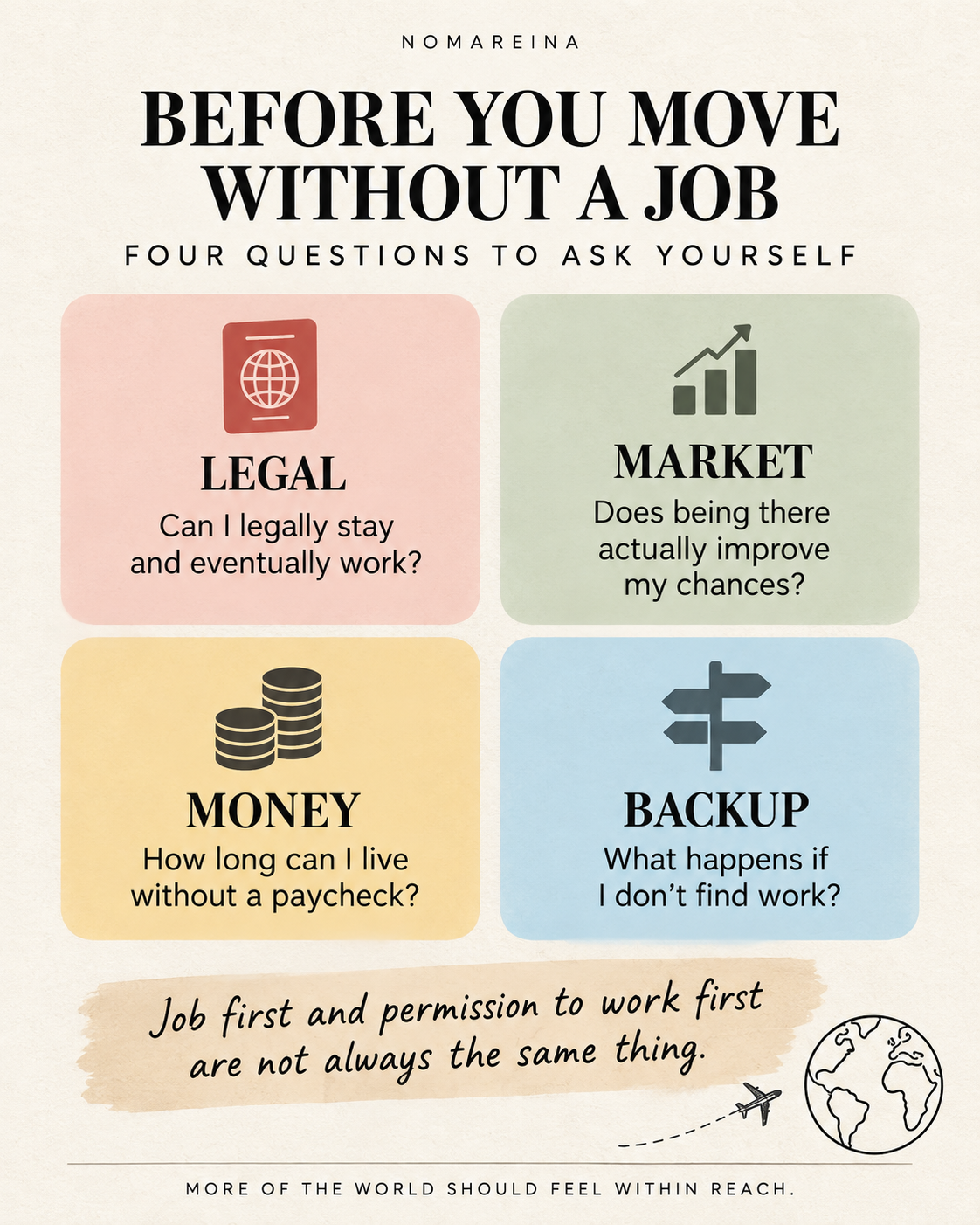
Before buying the ticket, I would want to know:
- Is my realistic chance of getting hired closer to 20 percent or 60 percent?
- What qualifications are employers actually requesting?
- Do companies regularly hire foreigners?
- Are there restrictions based on nationality, credentials or language?
- What do these jobs normally pay?
- Do employers prefer candidates who are already in the country?
- Can I talk to people already doing this work?
- How long can I support myself if the search takes longer than expected?
If everything I found suggested employers rarely hired someone with my background, I wouldn't build an entire relocation plan around the idea that I'd magically beat the odds once I landed.
Being adventurous and being reckless are not the same thing.
If you're moving before finding work, there may be a period when you don't have employer-provided coverage and need to arrange something yourself. SafetyWing's Nomad Insurance offers travel medical coverage for people living or traveling abroad. Read the actual policy, exclusions, deductibles and limits before deciding whether it fits your situation.
In 2026, I Think Showing Up Can Matter Even More
This is more observation than scientific theory, but I think AI has made the in-person part of hiring more interesting.
Anyone can take their experience, put it into an AI tool and come out with a beautifully written resume.
That doesn't mean the resume is fake.
But a polished application can only tell you so much about the person behind it.
Someone can look like the world's greatest teacher, marketer, project manager or whatever else on paper.
Then you have to walk into the room.
A conversation tells an employer things the resume can't:
- How do you communicate?
- Can you explain your experience without reading it back?
- Does the person sitting across the table match the person described in the application?
- Can they actually picture you doing the job?
For teaching especially, that mattered.
A school wasn't only hiring my resume.
They were hiring the person who would stand in front of students every day.
And I could show them that person.
My biggest advantage in Thailand wasn't just that I had a degree.
It was my science background plus my ability to show up whenever they called.
Give me five days' notice to fly to Chiang Mai?
Okay.
Tell me to be at the school at noon?
I was there at noon.
Resume in hand.
Dressed for the interview.
Ready to talk.
You can't do that as easily from another continent.
So, Should You Find a Job Before Moving Abroad?
If I could go back to 22-year-old me and tell her to move to Thailand without that first volunteer position?
Absolutely not.
She wouldn't have gone.
I needed something waiting for me.
That first opportunity gave me enough security to do something that already felt completely insane.
And I am glad I took it.
Eventually, being there put me in the right position to find something much better.
But I also wish I had researched more before accepting the first thing that made leaving possible.
Both things can be true.
So I wouldn't tell you:
Always find the job first.
And I definitely wouldn't tell you:
Just move. You'll figure it out.
Instead, I would ask:
- Can you legally live there while you search?
- Do you have a legal route to work once you find something?
- Are employers in your field actually willing to hire people with your nationality, credentials and experience?
- Does being physically present improve your odds?
- How long can you support yourself if finding a job takes longer than expected?
- What happens if the first offer isn't a good one?
- What is your backup plan if it doesn't work?
Because sometimes the job gets you into the country.
And sometimes getting into the country gets you the job.
You need to know which situation you're walking into.
I didn't.
I got lucky, learned quickly and eventually found my way.
You don't have to start as blindly as I did. That's the whole point of me telling you what happened.
You don't need certainty before you move. You need enough information to understand the risk you're choosing.
What kind of route actually fits your life?
If remote work is not your answer, there are still other legal ways to build a life abroad through teaching, local employment, study, working holidays, transfers and more.
Join the conversation
Would you rather find the job first or move first?
If you've looked for work abroad, what made the difference for you? Share what worked, what surprised you, or what you'd tell someone deciding which order to do it in. See the Policies & Disclaimers.