
I had already been living in Thailand long enough to understand that temples could surprise me.
A temple might be hundreds of years old or look almost new. It might sit behind a market, rise above a city, shimmer with mirrored tiles, or be somewhere I had passed ten times before finally noticing it.
I was not prepared for a dinosaur.
During my first stretch living in Thailand, I took a bus to Khon Kaen, a city in northeastern Thailand, or Isan, about an hour and a half from where I was living at the time.
I was still new enough to living abroad that my weekend travel strategy was barely a strategy:
- Find somewhere on the map.
- Get on a bus.
- See what happens.
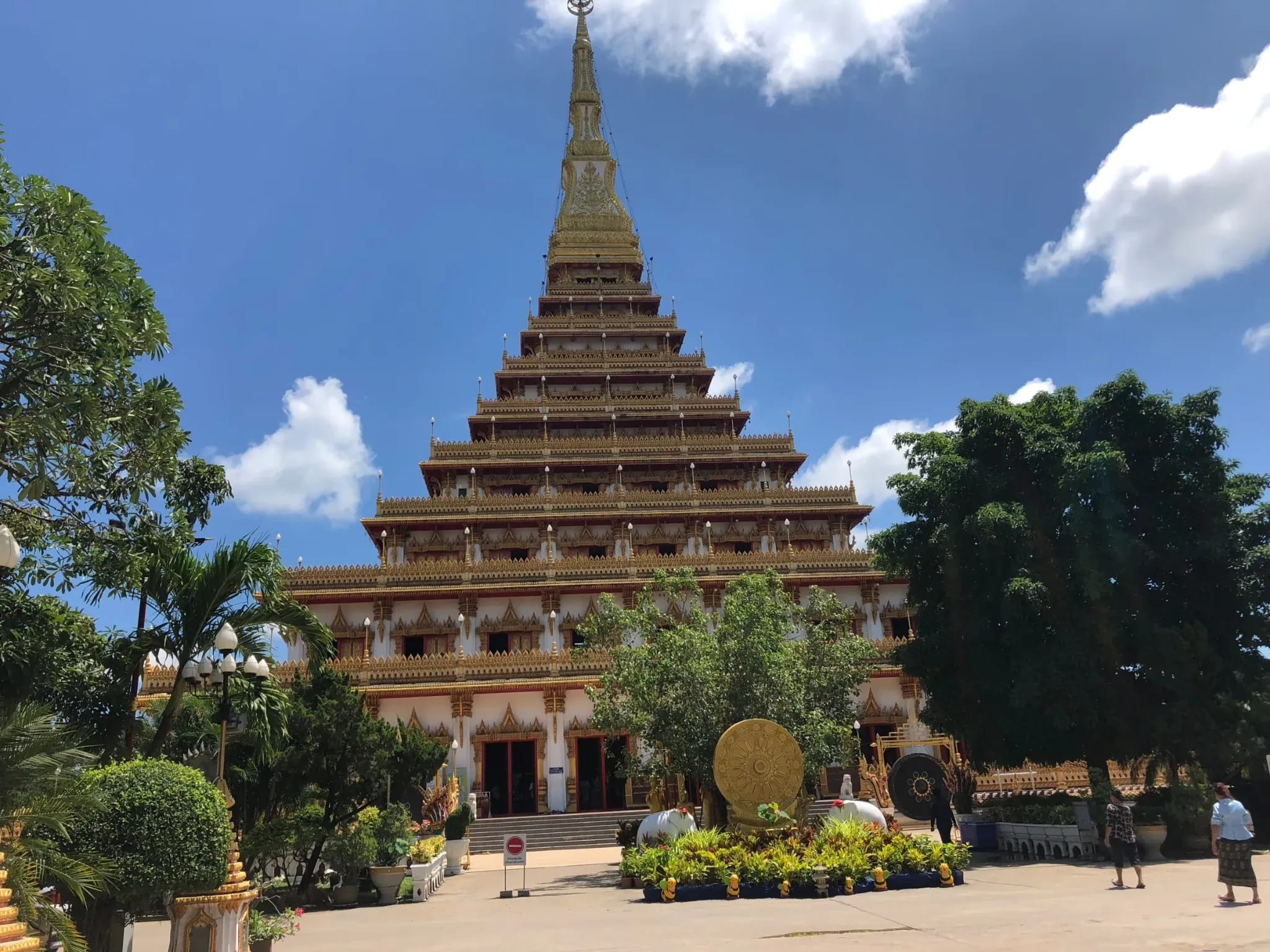
That particular weekend led me to Wat Nong Waeng, home to the nine-story Phra Mahathat Kaen Nakhon.
Khon Kaen, Thailand: The Quick Answer
- Where is Khon Kaen? In Isan, northeastern Thailand.
- Is Khon Kaen worth visiting? Yes for the right traveler, especially if you have time for Isan, regional culture, temples, or dinosaur history.
- Do I think it belongs on every first Thailand itinerary? No. Interesting does not have to mean mandatory.
- What would I prioritize? Wat Nong Waeng in the city, then Phu Wiang if fossils and dinosaurs are what brought you here.
- How long? One day works for the city. Give yourself at least two days if you want to add Phu Wiang.
- Biggest lesson: Khon Kaen helped me stop thinking of Thailand as one culture repeated from city to city.
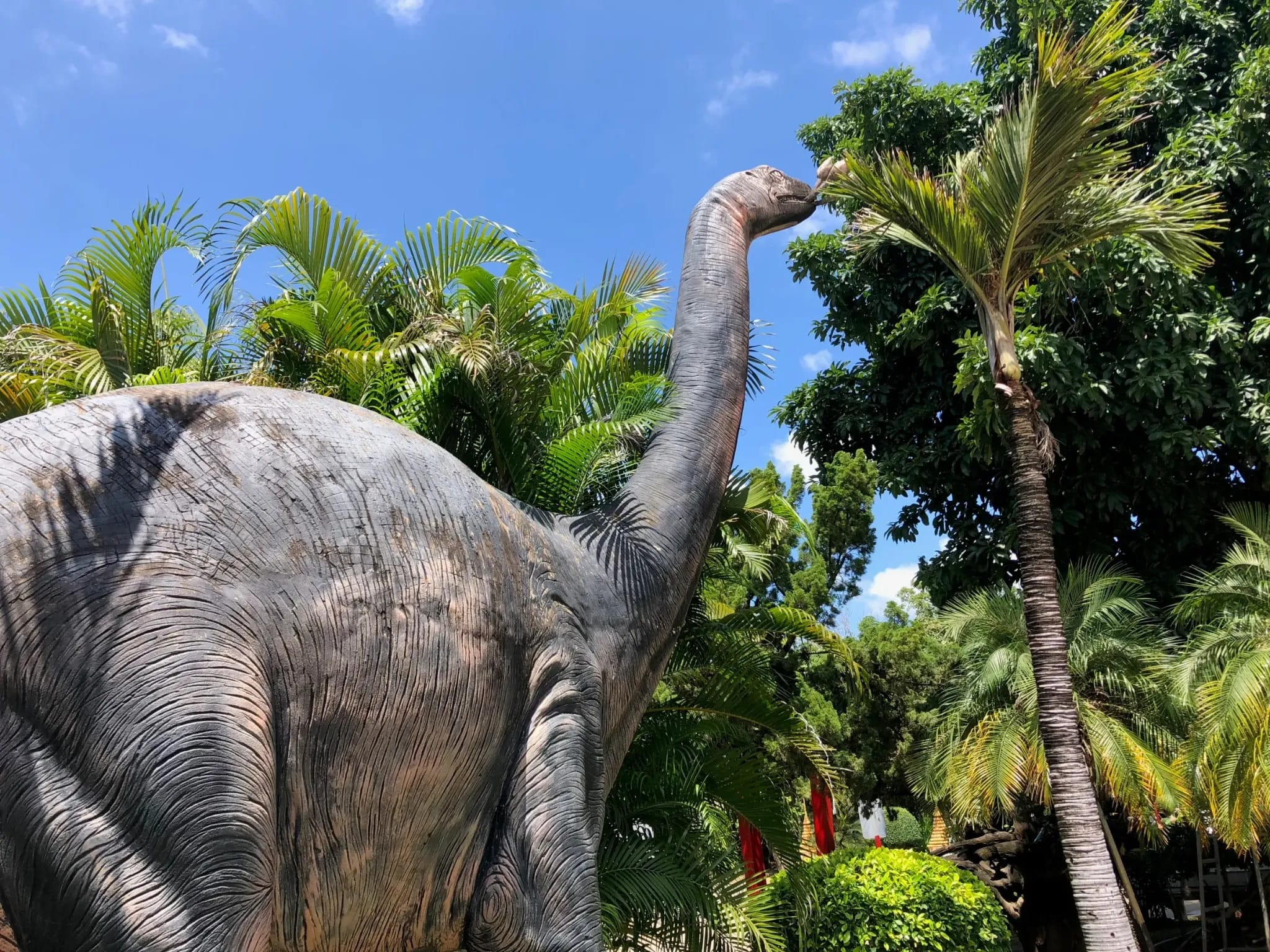
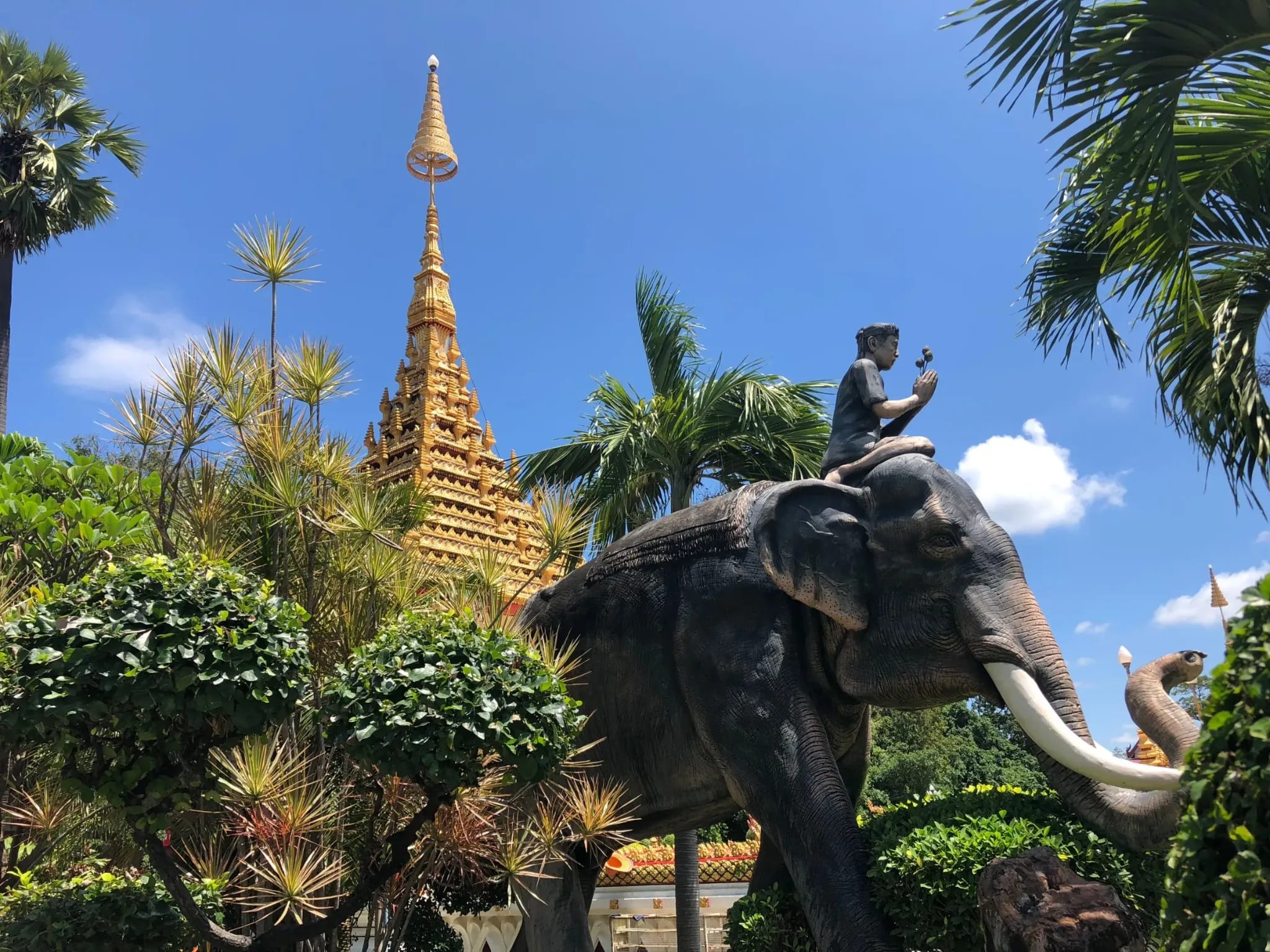
And somewhere on the temple grounds was a dinosaur.
Not a tiny dinosaur hidden among the landscaping.
A dinosaur replica.
Why is there a dinosaur at a Buddhist temple?
It turned out to be a much better question than I realized.
The Dinosaur Was Not as Random as I Thought
At the time, I treated it as one of those travel details you photograph because nobody at home is going to believe the sentence without evidence.
Temple.
Buddha images.
Religious artwork.
Dinosaur.
Sure.
What I did not understand was how closely dinosaurs are connected to this part of Thailand.
Khon Kaen province is one of Thailand's important fossil regions. Around Phu Wiang, dinosaur fossils have been uncovered, protected fossil sites were established, and the province developed the Phu Wiang Fossil Research Centre and Dinosaur Museum.
So the dinosaur I had dismissed as a wonderfully strange decorating decision belonged to a much bigger regional story.
I had walked straight into the context without knowing it.
That is one of my favorite things about traveling somewhere without researching every detail first.
Sometimes not knowing enough makes you miss something.
Sometimes it gives you the pleasure of realizing later that the thing you thought was random was telling you exactly where you were.
But the Dinosaur Is Not the Reason I Would Tell You to Visit Wat Nong Waeng
The dinosaur got my attention.
The temple kept it.
I remember taking off my shoes and beginning the climb through the nine-story structure.
- Floor after floor.
- Artwork.
- Religious imagery.
- Another staircase.
- Then another.
I had gone partly because I had heard about the unusual temple with the dinosaur.
By the time I reached the upper levels and looked out over Khon Kaen, the dinosaur felt almost beside the point.
What struck me more was how different this weekend felt from the Thailand I had known as a tourist.
I remember there being very few other foreign visitors inside the temple that Friday morning.
Nobody had discovered a secret Thailand.
Thai people already lived there. Thai travelers already knew it existed.
I had simply traveled outside the international route I knew best.
There is a difference.
Should You Actually Put Khon Kaen on a Thailand Itinerary?
My answer now is: it depends on what kind of Thailand trip you want.
If you have ten days in Thailand for your first trip and are already struggling to choose between Bangkok, Chiang Mai, and an island, I would not tell you to tear apart your itinerary because you absolutely must see Khon Kaen.
I like Khon Kaen.
I do not think every interesting place needs to become a must-see.
I would seriously consider it if:
- you have more time than the standard one- or two-week Thailand itinerary
- you are already traveling through Isan
- you live in Thailand and want a weekend trip
- temples interest you even when they are not internationally famous
- dinosaurs, fossils, or geology genuinely interest you
- you want a major Thai regional city that is not built primarily around international tourism
- you enjoy places where the reward comes from paying attention rather than completing a famous checklist
Khon Kaen is not an isolated village waiting to be discovered.
It is an important commercial, educational, and regional center in northeastern Thailand.
That is part of the appeal.
You are visiting a city that has reasons to exist beyond your vacation.
If the Dinosaur Is What Interests You, Do Not Stop at the Temple
This is something I wish I had understood when I first visited.
I saw the dinosaur at Wat Nong Waeng, took my photos, and mostly treated it as a funny travel story.
If I were planning the trip now specifically because the dinosaur made me curious, I would go farther.
The Phu Wiang Fossil Research Centre and Dinosaur Museum is the obvious next stop.
Its exhibits cover geology, fossils, and dinosaurs, and the wider Phu Wiang area includes actual fossil sites.
The temple gives you the strange photograph.
Phu Wiang gives you the reason the photograph makes sense.
That second layer is the one I missed.
How I Would Plan Khon Kaen Now
- Stay focused on Khon Kaen city.
- Make Wat Nong Waeng the anchor.
- Climb the temple and actually look at the artwork.
- Eat well.
- Go to a market.
- Notice what ordinary life looks like in a northeastern regional city.
- Keep the city day.
- Give the Phu Wiang area its own time.
- Add the fossil museum and wider dinosaur story.
- Do not try to squeeze the province into a rushed half-day detour.
Khon Kaen is also known for mudmee silk, another part of the province's cultural identity.
You do not have to see everything.
Let Khon Kaen be a city rather than a collection of attractions you have failed if you do not complete.
Getting From Bangkok to Khon Kaen
Khon Kaen is far enough from Bangkok that I would compare the current transport schedule before building the trip around an old travel blog.
Depending on your timing and budget, you may find buses, trains, or other overland options between Bangkok and Khon Kaen.
If Khon Kaen is one stop in a longer Thailand trip, this is exactly the kind of route where I would compare the timetable first and then decide whether the city fits naturally.
But Khon Kaen Also Taught Me Something Bigger About Thailand
The dinosaur was not the only thing I had misunderstood.
I had misunderstood the country.
Before moving there, I had absorbed a version of Thai culture as though there were one cuisine, one language, one architectural tradition, and one way of living that simply repeated itself from Bangkok to Chiang Mai to Khon Kaen to Phuket.
That is not how Thailand works.
There is a national identity and plenty of culture shared across the country.
But Thailand also has strong regional identities shaped by geography, former kingdoms, migration, neighboring countries, trade routes, languages, religion, and local history.
Living there eventually taught me to think in regions.
Khon Kaen was part of that education.
Isan: Northeastern Thailand
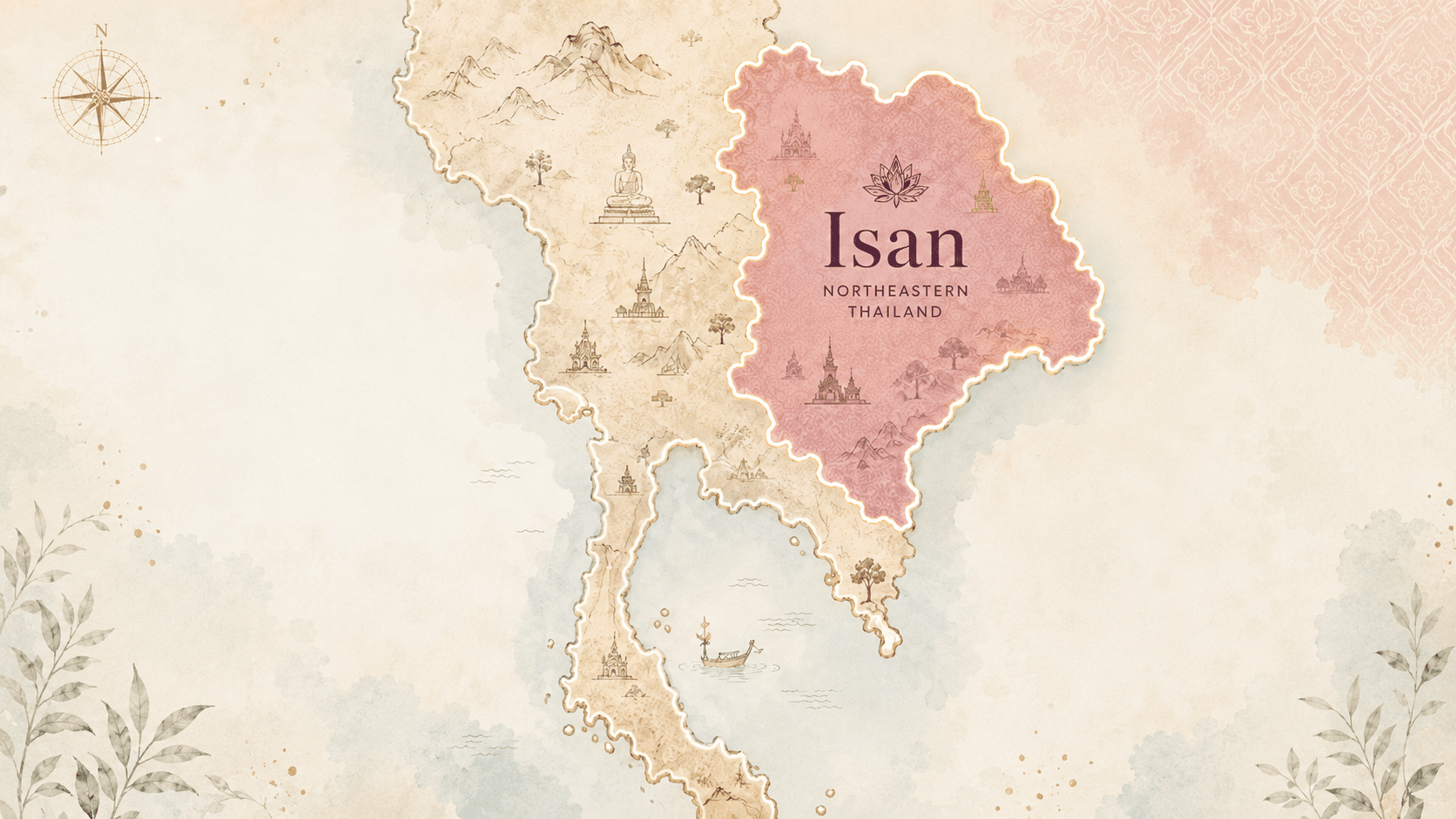
Khon Kaen sits in Isan, the northeastern region of Thailand.
Isan was also my first home in Thailand.
Before I ever lived in southern Thailand, before Thailand became familiar enough that I could compare one region with another, this was the version of the country I knew first.
Because of that, Isan will probably always have a special place in my heart.
My introduction to it was not through a sightseeing itinerary.
It was through ordinary life.
After work, I would walk home and stop at the same street-food seller.
My order almost never changed:
- sticky rice
- grilled pork
- and, if I was feeling fancy, som tam
At the time, a small bag of sticky rice cost me about 10 baht. A stick of grilled meat was usually 5 to 10 baht, and som tam was around 30 baht.
Those are prices from when I was living on a volunteer stipend, not a promise about what dinner costs in Thailand now.
Back then, they mattered because I was not making much money.
And I ate that meal constantly.
Sticky rice in one hand. Grilled pork in the other. Som tam if the budget allowed.
That became one of the rhythms I associated with coming home from work.
I had arrived in Thailand without much money, and I was not particularly good at managing the money I did have. On my first backpacking trip, I managed to get my bank account all the way down to $0.00. I tell that story in my Phuket article.
So when I talk about Isan food, I do not remember it first as something I ordered because a guidebook told me it was culturally important.
I remember it as dinner.
Only later did I understand how much those ordinary meals were teaching me about the region where I lived.
Across Isan, sticky rice is a staple rather than an occasional side dish. Pla ra, fermented fish, is deeply associated with northeastern cooking. Som tam, larb, grilled meats, and other foods I came to see everywhere belong to a culinary tradition shaped by the region's history, geography, and cultural connections with Laos.
Language carries some of that history too.
Across much of Isan, people speak varieties closely related to Lao alongside Central Thai. Isan music also reflects Lao and Khmer connections, including traditions such as mor lam and the khaen.
At 23, I did not arrive knowing how to identify all of those threads.
I learned backward.
First I ate the food.
Then I heard the language around me.
Then I noticed that the Thailand I was experiencing did not quite match the Thailand I had encountered as a tourist.
Only later did I begin learning why.
A Very Simplified Way to Understand Thailand's Regions
If you are new to Thailand, this is the shorthand I wish someone had given me.
It is intentionally simplified.
| Isan / Northeast | Northern / Lanna | Bangkok / Central | Southern Thailand | |
|---|---|---|---|---|
| Language you may hear | Central Thai plus Isan/Lao-related speech and other local languages | Central Thai plus Kham Mueang and other northern languages | Central Thai plus languages and dialects brought from across the country | Central Thai, Southern Thai, and Malay in parts of the lower South |
| Food clues | Sticky rice, som tam, larb, pla ra, grilled meats | Sticky rice, khao soi, sai ua, nam phrik noom, gaeng hung lae | Huge range of Central and regional foods | Seafood, intense spice, southern curries, Chinese and Malay influences depending on location |
| Some major influences | Lao, Mekong, and Khmer connections | Lanna, Myanmar, Laos, southern China | Royal court, trade, Chinese migration, national administration, modern migration | Maritime trade, Malay world, Chinese migration, Islam and Buddhism |
| What a visitor may notice | Strong regional identity outside the standard international circuit | Lanna culture remains visible even in tourist-heavy Chiang Mai | Influences from across Thailand concentrated in one enormous city | Major differences between resort islands, mainland cities, and culturally Malay areas |
The point is not to memorize the table.
It is to stop thinking Thai culture is one thing.
This table cannot tell you what every person in any of these regions believes, eats, or speaks.
It can tell you that moving through Thailand means moving through layers of regional history.
Once I understood that, I stopped asking:
Have I seen Thailand?
A better question became:
Which Thailand have I seen?
That regional difference is part of why Loi Krathong and Yi Peng are not the same festival, why Chiang Mai feels so different from Isan, and why Phuket changed for me once southern Thailand became ordinary life.
Khon Kaen Made Me Realize How Small My Mental Map of Thailand Was
Before I lived there, my Thailand map looked a lot like the international tourism industry's map of Thailand:
- Bangkok
- Chiang Mai
- Phuket
- Krabi
- Koh Samui
- Koh Phangan
- Pai
There is nothing wrong with those places.
Most became popular for reasons.
The mistake was assuming they represented the range of the country.
Once I started moving through places like Khon Kaen, I understood that I had not simply been missing destinations.
I had been missing regional cultures.
A city I had barely heard of could be a short bus ride away.
A weekend could take me somewhere I probably never would have planned an international vacation around.
Sometimes those became the trips I remembered most clearly.
Not because lesser-known automatically means better.
I do not believe that cliché either.
Some famous places are famous because they are extraordinary.
Some places outside the international tourist circuit genuinely have less for a visitor to do.
That is fine.
Travel does not always have to justify itself with a bucket list.
Sometimes the point is that you got on the bus.
The Temple Also Changed the Way I Research a Place
You do not need to research a destination until nothing can surprise you.
I actually think that can make travel worse.
But when something surprises you, follow the question.
- Why is that food everywhere here?
- Why does this temple look different from the ones I saw in Bangkok?
- Why are people speaking something I cannot understand even though I learned a little Thai?
- Why is this festival celebrated differently here?
- Why is there a dinosaur at a Buddhist temple?
Those questions can take you much deeper into a place than searching for another list of “10 things you cannot miss.”
The dinosaur was ridiculous enough to make me curious.
Curiosity led to geology.
Geology led back to Khon Kaen.
Khon Kaen led me to think more seriously about Isan.
And Isan eventually forced me to recognize that Thailand was far more regional than the version I had first encountered as a tourist.
How to Find Trips Like This Without Turning Travel Into Homework
I do not think the answer is chasing places nobody else has heard of.
That becomes its own form of travel performance.
You do not need to “discover” somewhere.
Instead:
- look one layer beyond the obvious route
- see what is two or three hours away before immediately booking another flight
- ask people living around you where they spend a weekend
- pay attention to regional museums, temples, festivals, and foods
- if you notice something odd, ask why it is there
- allow a small trip to remain small
Not every weekend needs to change your life.
Sometimes you see a temple.
Sometimes you eat something good.
Sometimes you learn that an entire part of Thailand has a dinosaur history you somehow never knew about.
That is enough.
This Was One of the Advantages of Living Abroad I Did Not Understand Before I Left
When I visited Thailand, I thought about travel in destinations.
When I lived there, I started thinking in weekends.
Where can I get to before I have to be back at work?
That changed my map.
Khon Kaen was not a once-in-a-lifetime vacation for me.
It was a weekend.
My job did not travel with me.
I was not moving from country to country with my laptop.
I had somewhere I needed to be again when the school week started.
But being stationary abroad still changed what was reachable.
I could visit somewhere because it was close.
I could choose a city because the bus ride was manageable.
I could spend a day seeing one temple without panicking that I had failed to maximize Thailand.
There was always another weekend.
That is part of why I push back on the idea that a life involving travel requires a job you can take anywhere.
Sometimes the job stays put. You move the weekends around it.
I wrote more about that in How Teaching in Thailand Made Travel Possible Without a Remote Job.
So, Is Khon Kaen Worth Visiting?
For the right traveler, yes.
Not because I think you need to collect every province in Thailand.
And not because Khon Kaen should replace every more famous destination.
I would probably skip it on a very short first trip if visiting meant sacrificing something you desperately wanted to experience elsewhere.
There are too many worthwhile places in Thailand for every recommendation to become mandatory.
The Weird Detail Is Sometimes the Doorway
I have forgotten plenty of technically important things from places I have visited.
I remember the dinosaur.
That probably says something about how travel memory works.
The detail that stays with you is not always the one a guidebook tells you is significant.
Sometimes it is ridiculous.
Sometimes it is beautiful.
Sometimes it is confusing.
Sometimes it looks completely out of place until you learn enough to understand that you were the one missing the context.
At the time, I thought I had found a Buddhist temple with a random dinosaur.
What I had actually found was one small piece of Khon Kaen telling me where I was.
I just did not know how to read it yet.
And maybe that is the part of travel I value more now.
Not knowing everything before I arrive.
Not pretending I understand a place after a weekend.
Just noticing enough to know when something is worth another question.
Khon Kaen, Thailand FAQ
Is Khon Kaen worth visiting?
Yes, for the right traveler. I would consider it if you have time for Isan, want a major regional Thai city outside the standard international route, or are interested in temples, fossils, and dinosaur history.
What is Khon Kaen known for?
Khon Kaen is a major city in northeastern Thailand and is known for regional Isan culture, Wat Nong Waeng, mudmee silk, and the wider province's dinosaur and fossil history around Phu Wiang.
How many days do you need in Khon Kaen?
One day can work for Khon Kaen city. I would allow at least two days if you want to add Phu Wiang and the dinosaur museum without rushing.
How do you get from Bangkok to Khon Kaen?
There are overland transport options between Bangkok and Khon Kaen. Because schedules and prices change, compare current options before you travel rather than relying on my old bus experience.
Is Khon Kaen in Isan?
Yes. Khon Kaen is in Isan, the northeastern region of Thailand. That regional context is a major part of what makes the city different from Bangkok, Chiang Mai, Phuket, or Southern Thailand.
Why are there dinosaurs in Khon Kaen?
Khon Kaen province has significant fossil sites, especially around Phu Wiang, where dinosaur discoveries led to protected fossil areas, research, and a dedicated dinosaur museum.
Join the conversation
What detail made you curious enough to look deeper?
Have you ever noticed something while traveling that seemed random until you learned the history or culture behind it? See the Policies & Disclaimers.